




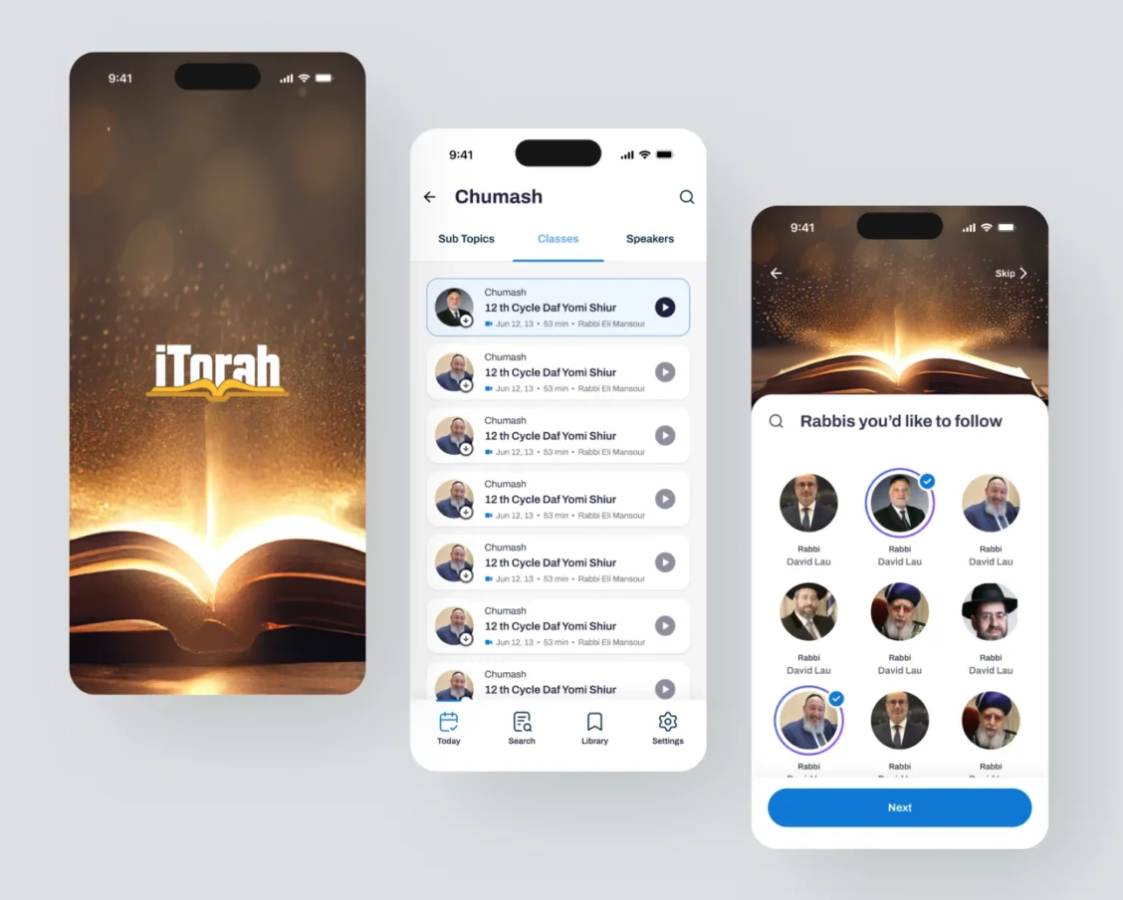
The iTorah app is a digital product that helps people learn Torah and other Jewish texts. It typically has access to translations, commentaries, audio lessons, and personalized study plans. It’s useful for both people from the Jewish community who cherish traditions and those who want to learn more about this move. In 2026, such apps will become even smarter with AI evolving, so it gives explanations and show content tailored to the user’s needs. The target audience of Torah apps is usually both observant Jews (for daily study) and people who study Judaism or biblical texts in a convenient “on-the-go” format.
Growing demand for Torah study apps in the digital age
In 2025 and 2026, demand for Torah apps and its studying rise noticeably because of a real need. People want to follow Jewish traditions and stay connected to Jewish culture, but they don’t have time or ways to engage in traditional learning. That’s where Torah apps for Android and iOS close this gap in 2026.
First, interest in Jewish education is clearly growing. Participation has risen by 23% since 2023, and about 33% of adult Jews are already learning through educational programs, with many wanting more.
Second, the apps themselves are scaling fast. Platforms for Torah learning have 130K+ downloads, with huge libraries of lessons and texts, showing real, ongoing demand.
Third, tech is pushing this even further in the age of AI. So, today’s apps now include AI features, personalized study paths, voice tools, and cross-platform access.
Key features every modern Torah study app should include in 2026
In 2026, to bring more value for people who learn Torah and make their experience easy and pleasant, include these features in your app:
- Access to texts (Torah, Talmud, commentaries) with translations.
- AI explanations and content personalized to the user’s needs.
- Audio and video lessons for learning “on the go”.
- Search and quick navigation between texts and commentaries.
- Offline access to materials.
- Interactivity: bookmarks, notes, text highlighting.
- Community features (groups, discussions, collaborative learning).
- Cross-platform support (mobile + web synchronization).
- Simple, intuitive UX without clutter.
Let your users feel how much the Torah treasure app and how learning can actually feel pretty enjoyable.
Technologies used in Torah study app development
To build Torah study app, the development team uses the same technologies as for other mobile apps, but here may be added ones that improve its productivity or help implement unique features. Typically, the list of technologies covers:
Frontend part – React and Next.js (for web version), React Native or Flutter (for mobile app itself). Backend part – Node.js, Python (Django/FastAPI). For databases – PostgreSQL and MongoDB.
Others:
- API-first architecture.
- Headless CMS (Strapi, Contentful, Sanity) for content management.
- Cloud infrastructure (AWS, Google Cloud, Azure).
- AI/ML integrations for text explanations and personalization.
- Audio/video streaming services (for lectures).
- Push notifications and background services.
User experience and accessibility in Torah study apps
In 2026, Torah study apps are all about getting users straight to the content without confusion. You open the app and can immediately start reading, listening, or studying. That’s why clean structure, fast search, simple navigation, and minimal steps are key. Do what you need from the first seconds without the need to explore how it actually works. That’s the key to a positive user experience.
Accessibility is also an important factor within the Torah apps. It supports all levels (from beginners to advanced), translations, audio mode for hands-free learning, adjustable fonts and contrast, plus offline access.
Challenges in Torah study app development and how to address them
As Torah study app is a specific product, it may have a few challenges during its development. Nevertheless, every challenge has a proper solution. Check them out:
- The complexity of working with ancient texts (Hebrew, Aramaic). To solve it, use high-quality translations, parallel texts, and AI-generated explanations to provide clear context.
- Large volume of content. Leverage headless CMS + structured databases and well-designed navigation.
- Accuracy and reliability of religious content. Ensure close collaboration with experts and verified sources.
- Complex UX due to multi-layered texts (commentaries, interpretations). Focus on the interface with separate information levels.
- Offline access to large libraries. Implement caching and content optimization.
- User engagement in long-term learning. Provide users with streaks, reminders, progress tracking, and community features.
- Localization for different languages and cultures. Think about multilingual architecture with flexible translations from the very beginning.
Security, content accuracy, and community integration within the app for Torah study
Security features protect user data and content with encryption, secure login, access control, and stable cloud infrastructure. Thus, everything from study materials to personal notes stays safe.
Content accuracy makes sure everything is based on verified sources, with input from religious experts and well-structured text libraries. AI can help with explanations, but only grounded in trusted content. So, users will see only real and relevant information.
Community integration covers supporting shared learning through discussions, groups, study plans, and notes, while keeping things respectful and well-moderated.
Conclusion
iTorah app development in 2026 shows how modern educational tools for religious learning are becoming more digital and accessible. The real value lies in combining accurate content, strong UX, and technology that lets people learn anytime, in any format they prefer.