





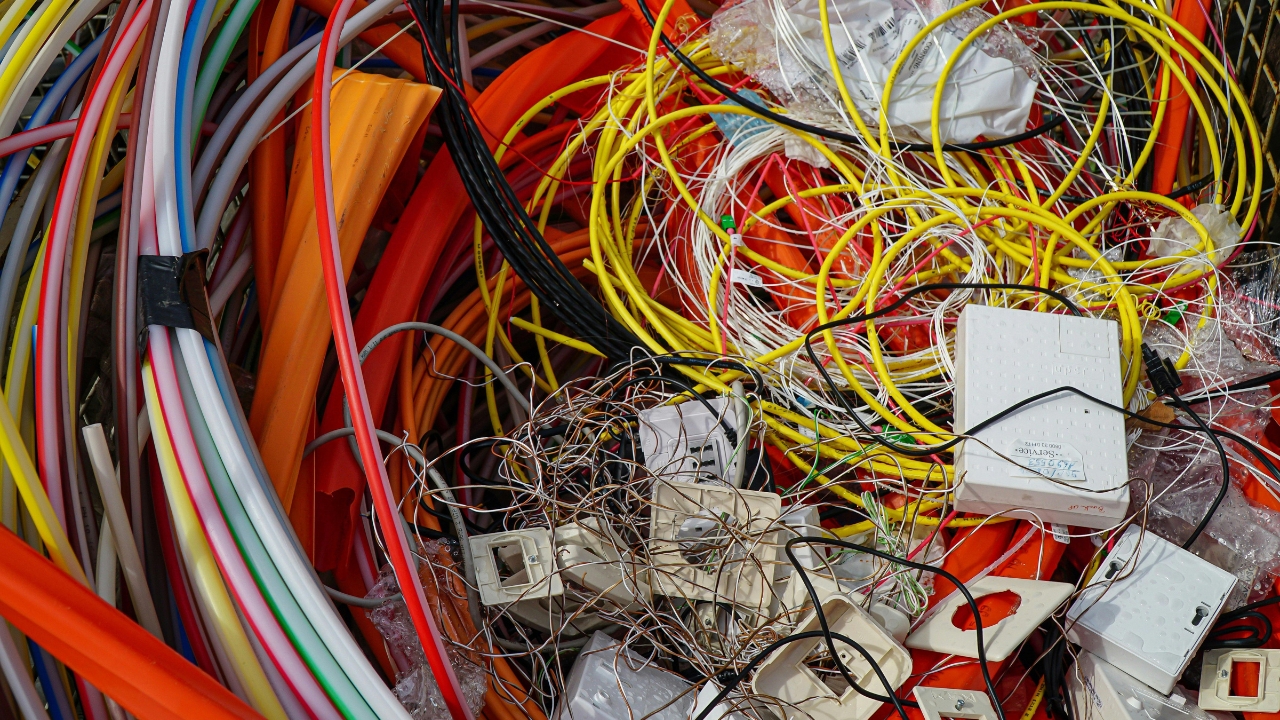
Most conversations about reducing material waste start with behavior, better habits, more training, tighter compliance. But in industrial processing, the bigger culprit is usually the system itself. Poorly designed flow paths, blocked hoppers, and leaking transfer points don’t just slow production down. They bleed material continuously, and most of that loss gets written off as normal.
It’s not. Here’s where to actually look.
Audit Your Waste Streams Before Changing Anything
Before spending money on equipment, run a material mass balance across your facility. Track every input against every measured output and account for what’s left. The gaps, dust, spillage, off-spec scrap, stagnant material that never discharges, are your actual waste categories.
A waste stream audit lets you prioritize. Some losses are high volume but cheap to fix. Others are smaller but represent expensive processed material. Treating everything the same is how facilities spend resources on the wrong problems first.
Fix How Bulk Solids Move Through Storage Vessels
The expense involved in throwing away materials and cleaning out vessels can be huge. Separating the product from contaminants or foreign bodies and reworking the stock costs time and money as well. The best way to deal with these issues is to minimize the volume of discarded material.
Mechanically agitating the blocked area is the most common approach. Mounting external vibrators on the walls of bins and hoppers is one of the more reliable methods for cohesive or sticky materials, the controlled vibration breaks the friction between particles and the vessel wall. Flooding the area with air or some other gas is another common choice, though it threatens to damage the vessel if the pressure is too high, ducting can be complex and energy consumption goes up. Then there’s shooting everything with water, flow aids like liners and slick coatings to prevent build-up in the first place, none of which are effective if your problem is more about the geometry of the hopper than the flow characteristics of the material.
Stop Treating Dust as an Acceptable Loss
In dry processing environments, dust is not just a danger as it floats inside. This also signifies that the product is exiting the facility. Closed-loop conveyance systems and appropriately constructed dust control mechanisms gather what open mechanisms miss. The product that accumulates on beams and the ground, or seeps via subpar filters, was bought at the similar cost as the product that was shipped.
Pneumatic conveyance lines are especially prone to this if not set precisely. Velocity too high and you get particle degradation and additional dust. Too low and the material falls out of suspension and amasses in the line. Neither is free.
Calibrate Equipment on a Fixed Schedule, Not When Something Breaks Down
Predictive maintenance is based on the principle that it’s more cost-effective to prevent breakdowns than to fix them after the fact. This is because fixing the equipment after it breaks leads to downtime and possibly loss of production. In addition, repairs may be more extensive and costly than catching issues early when they’re still minor.
The use of sensors to monitor equipment allows for real-time data collection and analysis. When the data indicate that a part is wearing down, maintenance teams can schedule the machine for repairs during the next convenient maintenance window. This prevents the machine from breaking down unexpectedly and producing off-spec material.
This approach has a better cost/benefit ratio than running the equipment to failure, because the cost of off-spec material and the related repairs and operational inefficiencies is greater than the cost of the planned maintenance.
Close the Loop on By-Products
Every element that is discarded during primary production is not really waste. Some by-products of processing may be returned to the production line. Some can even be sold or used as raw materials or be subjected to further processing. The recycling (or, even better, upcycling) frame is particularly recommended here. Not because it is fashionable, but because it accurately describes the situation: much of the “surplus” that is discarded as waste is actually recoverable material necessitating a value assessment.
The first step might be to create a recyclable, reusable, or recoverable category of waste beyond the legal definition. Start by collating and characterizing current waste streams by volume, composition, and steps that would be needed to manage them. Some by-products may clearly represent raw materials and / or energy for your facility’s next product or process. Some won’t. However, it may be said that until a category exists, it is impossible to determine into which compartment a specifically discarded resource should go.
Precision Matters More at Transfer Points Than Anywhere Else
Transfer points are locations where spillage is most likely to occur. When material is being transported from one conveyor to another, from a storage vessel to a processing system, or from a railcar to a truck, it’s extremely easy to lose product over the sides or ends of the receiving conveyor.
Anything that can be done to minimize the risk of overfilling at transfers will have a direct and immediate positive effect on the plant’s bottom line. Proper chute design and selection, consistent belt loading, and transfer point sealing are all critical. Other obvious spill points include poorly fitting or misaligned feed chutes and loading zones, non-matching belt speeds, material freefalling, and using the wrong type of belt for the material being conveyed.
Reducing material waste in processing facilities isn’t complicated in principle. The losses are mostly mechanical. Fix the physics, and the numbers follow.


